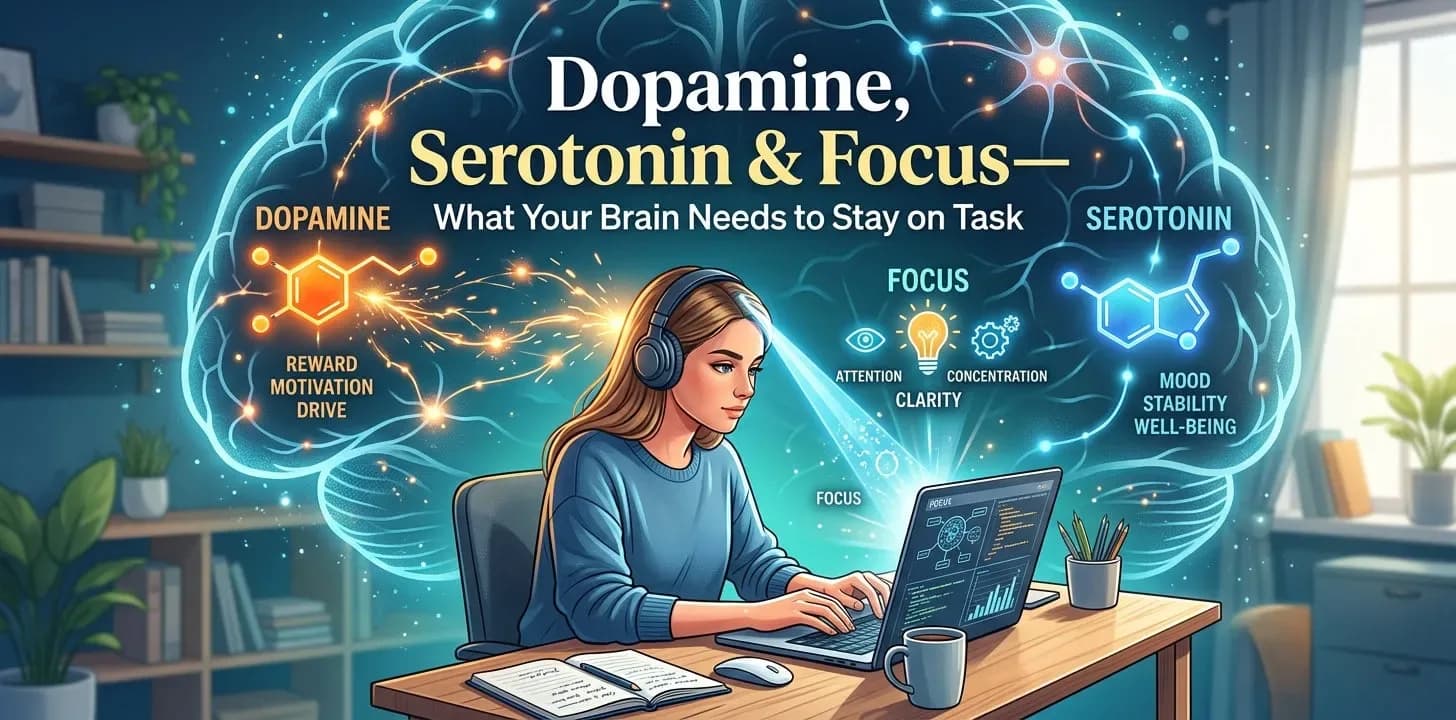
Dopamine, Serotonin and Focus: What Your Brain Needs to Stay on Task
Scrolling takes little effort while focusing on an important task for twenty minutes can feel hard, partly because stimulation and sustained cognitive performance rely on different brain processes. Dopamine helps drive the pursuit of goals while serotonin plays a different role in mood and regulation, and both depend on sleep, nutrition and daily habits. This article from the Hooked series explains the biology and which nutrients are discussed in relation to it.
Autor: Root Health TürkiyeZveřejněno Aktualizováno Doba čtení: 5 min
Scrolling takes little effort while focusing on an important task for twenty minutes can feel hard, partly because stimulation and sustained cognitive performance rely on different brain processes. Dopamine helps drive the pursuit of goals while serotonin plays a different role in mood and regulation, and both depend on sleep, nutrition and daily habits. This article from the Hooked series explains the biology and which nutrients are discussed in relation to it.
...but struggle to concentrate on something important for twenty minutes?
Part of the answer may lie in the difference between stimulation and sustained cognitive performance.
Your brain contains multiple neurotransmitter systems involved in motivation, attention, mood and behavior. Two that receive enormous attention are dopamine and serotonin.
They're often presented as "happy chemicals."
The real biology is considerably more interesting.
Dopamine Helps Drive the Pursuit
Dopamine participates in motivation, reward prediction, learning and goal-directed behavior.
Think of it as part of the system that helps answer:
"Is this worth pursuing?"
When something potentially rewarding appears—a message, new video, notification or social response—the brain learns that checking may produce a payoff.
Research on social media supports the connection between online social feedback and reward-related brain circuitry. Popular content and social approval have been associated with activity in areas including the nucleus accumbens. (PubMed Central (PMC))
The problem isn't dopamine itself.
You need dopamine.
The question is what you're training yourself to pursue.
Serotonin Plays a Different Role
Serotonin is involved in a remarkably broad range of biological functions, including aspects of mood and behavior.
It isn't accurate to say dopamine equals excitement and serotonin equals happiness. Human neurochemistry is much more complex than that.
But it is reasonable to say that both systems matter to normal brain function—and both depend on underlying biology and nutritional status.
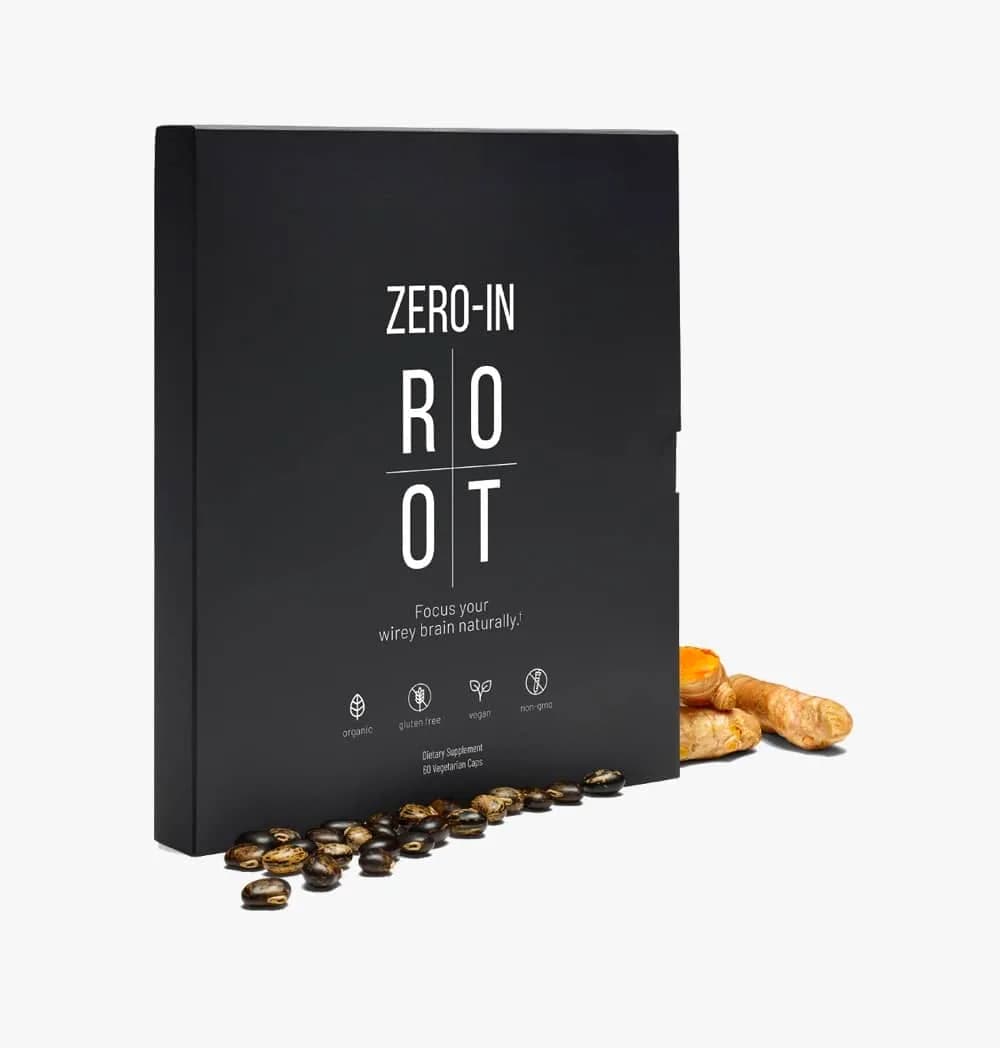
That gives us an interesting way to look at Zero In.
Zero In Wasn't Built Around One Ingredient
One of the strengths of the formula is that it approaches cognitive support from multiple directions.
N-Acetyl L-Tyrosine
Tyrosine sits upstream in catecholamine synthesis.
The pathway ultimately contributes to the formation of dopamine, norepinephrine and epinephrine.
That makes tyrosine especially interesting when cognitive demands are high.
In a recent randomized study involving a stressful simulated training scenario, participants receiving L-tyrosine had fewer missed responses on one cognitive task than participants receiving placebo, although not all measured outcomes improved. (PubMed)
Older controlled research has similarly reported benefits on certain cognitive tasks performed under stressful conditions. (PubMed)
Velvet Bean Seed
Zero In also contains velvet bean seed, or Mucuna pruriens.
Mucuna is notable because its seeds naturally contain L-DOPA, the immediate metabolic precursor to dopamine.
A recent scientific review describes the high L-DOPA concentration of Mucuna seeds and notes that L-DOPA can enter the brain, where it participates in dopamine production. (PubMed Central (PMC))
That biological mechanism is one reason ROOT's formulation materials categorize velvet bean as part of Zero In's dopamine support strategy.
Vitamin D3 and Serotonin Biology
Vitamin D is especially interesting because researchers have identified a possible connection between vitamin D signaling and enzymes involved in serotonin synthesis.
One proposed mechanism involves tryptophan hydroxylase 2 (TPH2), an enzyme involved in serotonin production in the brain. Laboratory research has shown that active vitamin D can influence TPH2 gene expression. (PubMed)
But here's the important scientific qualifier:
A 2024 systematic review and meta-analysis of six randomized trials found that vitamin D supplementation did not produce a statistically significant overall increase in measured serum serotonin. (PubMed)
So the responsible claim isn't:
"Vitamin D raises everyone's serotonin."
It's:
Vitamin D participates in biology associated with serotonin regulation, while clinical evidence regarding supplementation and serotonin levels remains mixed.
That's both stronger science and better marketing.
L-Theanine + Caffeine: Focus From Another Angle
Dopamine and serotonin aren't the entire focus story.
Zero In also pairs caffeine with L-theanine.
Caffeine promotes alertness.
L-theanine, an amino acid naturally found in tea, has been studied alongside caffeine for its effect on attention.
In a randomized, placebo-controlled crossover study, 97 mg of L-theanine plus 40 mg caffeine improved performance on an attention-switching task compared with placebo. (PubMed)
Other controlled studies have also found potential attention benefits from the combination. (PubMed)
That makes this combination particularly relevant to the digital-age problem.
We don't just need to be awake.
We need to be able to direct attention intentionally.
Where Zero In Fits
Zero In shouldn't be positioned as a magic antidote to social media.
It's more interesting than that.
Think of it as nutritional support within a bigger focus strategy:
Dopamine-pathway support. Serotonin-related nutritional support. Calm alertness. Cognitive-supporting botanicals. Better digital habits.
You still have to put the phone down.
But when you do, the goal is to have the focus and motivation to do something worthwhile with the attention you've reclaimed.
Support the Chemistry Behind Better Focus Your brain depends on nutritional building blocks to support normal neurotransmitter function and cognitive performance. Zero In combines ingredients selected to support dopamine-related pathways, serotonin-related biology, calm alertness, and mental clarity in one daily formula. Give your brain nutritional support for the focus you’re asking from it. Try Zero In.
References
Patrick RP, Ames BN. Vitamin D hormone regulates serotonin synthesis. Part 1. FASEB Journal. 2014. (PubMed)
Alimohammadi-Kamalabadi M, et al. Does vitamin D supplementation impact serotonin levels? A systematic review and meta-analysis. Health Science Reports. 2024. (PubMed)
Einöther SJL, et al. L-theanine and caffeine improve task switching but not intersensory attention or subjective alertness.Appetite. 2010. (PubMed)
Attipoe S, et al. Tyrosine for Mitigating Stress and Enhancing Performance in Healthy Adult Humans. Military Medicine. 2015. (PubMed)
Zdroje
- Patrick RP, Ames BN. Vitamin D hormone regulates serotonin synthesis. Part 1. FASEB Journal. 2014. ( PubMed )
- Alimohammadi-Kamalabadi M, et al. Does vitamin D supplementation impact serotonin levels? A systematic review and meta-analysis. Health Science Reports. 2024. ( PubMed )
- Einöther SJL, et al. L-theanine and caffeine improve task switching but not intersensory attention or subjective alertness. Appetite. 2010. ( PubMed )
- Attipoe S, et al. Tyrosine for Mitigating Stress and Enhancing Performance in Healthy Adult Humans. Military Medicine. 2015. ( PubMed )