The Focus Reset: A Daily Strategy for Taking Back Your Attention (Hooked Part 5)
Understanding why you are distracted is useful, but changing what you do next matters more. A practical daily routine includes not letting your phone choose your first thought, deciding what deserves your attention and building supportive habits such as consistent sleep and balanced nutrition. This final part of the Hooked series turns the earlier science into a simple routine and explains where Zero-In fits.
Autori: Root Health TürkiyePublikuar më Përditësuar më 5 min lexim
Understanding why you are distracted is useful, but changing what you do next matters more. A practical daily routine includes not letting your phone choose your first thought, deciding what deserves your attention and building supportive habits such as consistent sleep and balanced nutrition. This final part of the Hooked series turns the earlier science into a simple routine and explains where Zero-In fits.
Changing what you do next is better.
So let's turn everything we've discussed into a practical daily routine.
No digital monastery.
No throwing your phone into the ocean.
No promise that you'll suddenly become immune to distraction.
Just a better environment for your brain.
Step 1: Don't Let Your Phone Choose Your First Thought
When you wake up, resist the urge to immediately enter everyone else's world.
No email.
No news.
No social feed.
No notifications.
Give yourself the first portion of your morning.
Your HOOKED framework recommends protecting the first 30–60 minutes from unnecessary phone stimulation as one practical way to change the relationship with digital cues.
Use that time for real-world signals instead.
Light.
Water.
Movement.
Breakfast.
Planning.
Conversation.
Step 2: Decide What Deserves Your Dopamine
Before opening social media, identify one meaningful target for the day.
Ask:
What accomplishment would make today feel productive even if nothing else happened?
Write it down.
Now your reward system has somewhere intentional to point.
Instead of:
check → scroll → reward → repeat,
you begin creating:
effort → progress → completion → reward.
That's an important shift.
Step 3: Build Zero In Into the Routine
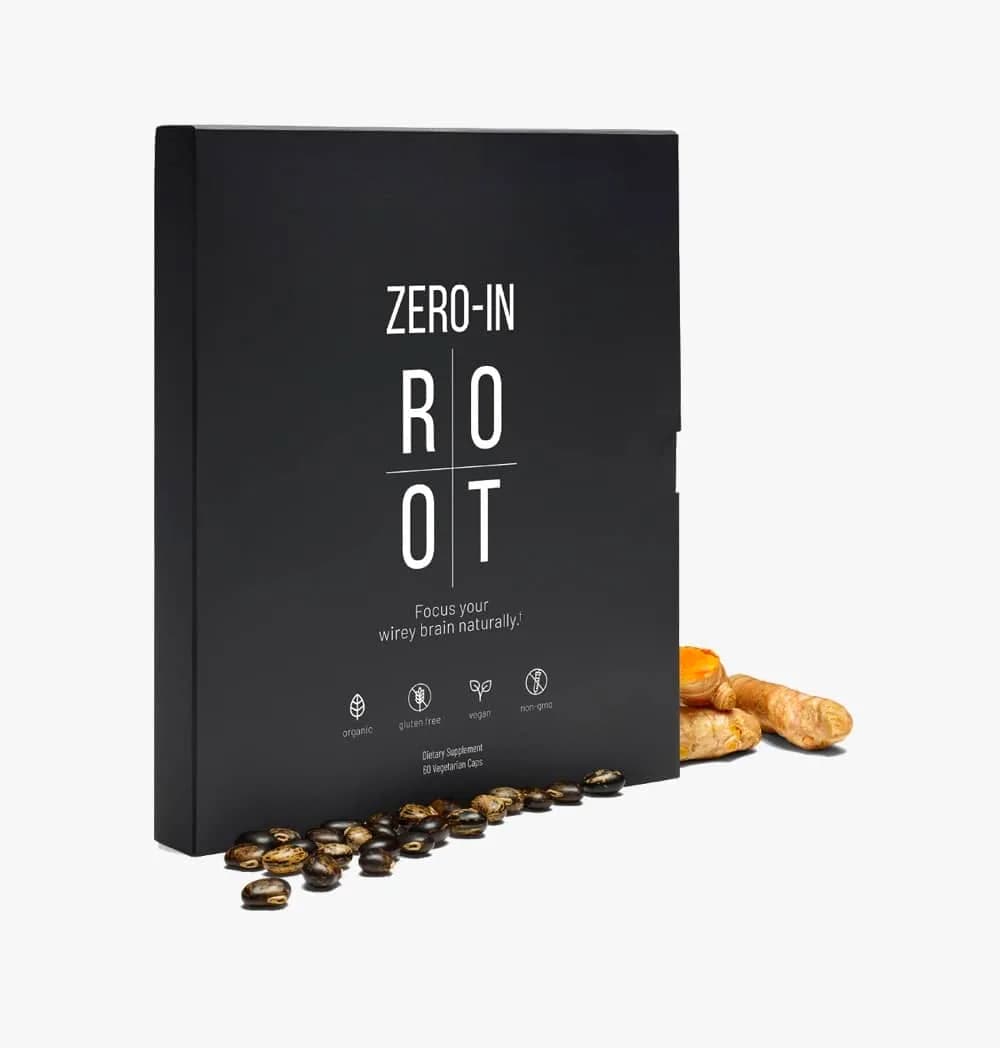
This is the natural point for Zero In.
Not because Zero In replaces discipline.
Not because it makes social media disappear.
But because you're deliberately building a routine around focus, mental clarity, alertness, energy and motivation—the same categories used in ROOT's Zero In positioning.
The formula brings several complementary components together.
Caffeine + L-Theanine
For alertness and attention support.
Randomized controlled research has found attention-related benefits from this combination in several settings. (PubMed)
N-Acetyl L-Tyrosine
Provides a form of tyrosine, which sits in the biochemical pathway used to synthesize catecholamine neurotransmitters.
Research on tyrosine has shown potential cognitive benefits particularly during demanding or stressful conditions, although the overall evidence does not justify universal performance claims. (PubMed)
Velvet Bean
Provides naturally occurring L-DOPA, a direct dopamine precursor. (PubMed Central (PMC))
Vitamin D3
Participates in numerous biological processes and has mechanistic links to genes involved in serotonin synthesis, although supplementation has not consistently been shown to raise serum serotonin in randomized trials. (PubMed)
Pine Bark + Turmeric
These botanicals add polyphenolic and antioxidant-related components to the broader formulation strategy. Human cognitive findings vary, which is why they are best discussed as part of the formula's overall support approach rather than as standalone cures for cognitive problems. (PubMed)
Step 4: Work Before You Scroll
Here's a simple rule:
Create before you consume.
Write before scrolling.
Exercise before scrolling.
Study before scrolling.
Build before scrolling.
Complete something before asking your brain to process hundreds of other people's ideas.
That one principle can completely change the way a morning feels.
Step 5: Use Focus Blocks
Start with 30–45 minutes.
One objective.
Phone out of reach.
Then take a short break.
Repeat.
Your ability to concentrate doesn't need to be perfect on Day One.
It's something you practice.
Step 6: Put Natural Rewards Back Into Your Day
The answer to excessive digital reward isn't removing reward from life.
It's rebuilding the good kind.
Exercise.
Sunlight.
Finishing something difficult.
Learning.
Laughing with somebody in person.
Creating.
Working toward something that matters.
Going outside.
These experiences require more effort than swiping.
That's part of what makes them meaningful.
Step 7: Control the Last Hour Too
Your phone shouldn't necessarily get the first moment of your day or the last.
Create a nightly cutoff.
Charge it away from your bed if possible.
Give your mind an actual endpoint.
Tomorrow, begin again.
Zero In + Zero Distraction
This entire five-part series comes down to one idea:
You cannot supplement your way out of an environment designed to distract you.
But you also don't have to ignore nutritional support while improving that environment.
That's the intersection where Zero In makes sense.
Change the cues.
Reduce unnecessary stimulation.
Protect your attention.
Build meaningful goals.
Support the nutritional pathways associated with cognitive performance.
Then direct that focus toward something that matters.
The goal was never to quit technology.
The goal is to decide who's in control.
Your phone—or you.
Make Zero In Part of Your Focus ResetPut the phone down. Get outside. Move your body. Protect your sleep. Choose what deserves your attention—and support your brain while you do it. Zero In brings together targeted nutrients and botanicals designed to support mental clarity, sustained focus, alertness, energy, and motivation.
Less distraction. More intention. Get Zero In TODAY.
References
Einöther SJL, et al. L-theanine and caffeine improve task switching but not intersensory attention or subjective alertness.Appetite. 2010. (PubMed)
Attipoe S, et al. Tyrosine for Mitigating Stress and Enhancing Performance in Healthy Adult Humans. Military Medicine. 2015. (PubMed)
Patrick RP, Ames BN. Vitamin D hormone regulates serotonin synthesis. FASEB Journal. 2014. (PubMed)
Alimohammadi-Kamalabadi M, et al. Does vitamin D supplementation impact serotonin levels? Health Science Reports. 2024. (PubMed)
Wang W, et al. The effect of curcumin supplementation on cognitive function: an updated systematic review and meta-analysis. Frontiers in Nutrition. 2025. (PubMed Central (PMC))
Related topics: L-Theanine, Velvet Bean.
Referencat
- Einöther SJL, et al. L-theanine and caffeine improve task switching but not intersensory attention or subjective alertness. Appetite. 2010. ( PubMed )
- Attipoe S, et al. Tyrosine for Mitigating Stress and Enhancing Performance in Healthy Adult Humans. Military Medicine. 2015. ( PubMed )
- Patrick RP, Ames BN. Vitamin D hormone regulates serotonin synthesis. FASEB Journal. 2014. ( PubMed )
- Alimohammadi-Kamalabadi M, et al. Does vitamin D supplementation impact serotonin levels? Health Science Reports. 2024. ( PubMed )
- Wang W, et al. The effect of curcumin supplementation on cognitive function: an updated systematic review and meta-analysis. Frontiers in Nutrition. 2025. ( PubMed Central (PMC) )