Why Social Media Keeps Winning the Battle for Your Attention
Social platforms make checking feel worthwhile by combining short-form content, social approval and endless feeds, which create repeated opportunities for reward-seeking. Focus is a different skill that depends on your environment and on basics such as sleep and nutrition. This part of the Hooked series explains why social approval is such a strong reward and what steps help you take back attention.
Autori: Root Health TürkiyePublikuar më Përditësuar më 5 min lexim

Social platforms make checking feel worthwhile by combining short-form content, social approval and endless feeds, which create repeated opportunities for reward-seeking. Focus is a different skill that depends on your environment and on basics such as sleep and nutrition. This part of the Hooked series explains why social approval is such a strong reward and what steps help you take back attention.
It only has to make checking feel worthwhile.
That's an important distinction.
The most successful digital platforms have removed almost every bit of friction between wanting stimulation and receiving stimulation.
Swipe.
Tap.
Refresh.
Watch.
Repeat.
In the HOOKED framework, mechanisms such as short-form content, social validation, notifications and endless feeds create repeated opportunities for reward-seeking.
Social Approval Is a Powerful Reward
Humans cared about social acceptance long before Instagram existed.
That's why likes, comments and follower counts can be so compelling.
They're digital numbers attached to something biologically ancient:
Do other people approve of me?
Brain-imaging studies have shown that seeing highly liked content and receiving positive social feedback can activate reward-associated areas such as the nucleus accumbens. (PubMed Central (PMC))
One study even found that individual differences in nucleus accumbens responses to reputation-related rewards predicted Facebook use. (PubMed Central (PMC))
This doesn't mean Facebook or Instagram is pharmacologically equivalent to a drug.
It tells us social feedback is genuinely rewarding to the human brain.
Then Comes the Next Reward
The unique feature of your phone is speed.
A person can encounter dozens or hundreds of:
videos,
headlines,
messages,
pictures,
comments,
notifications,
and social reactions...
...in a single sitting.
Compare that with working toward a meaningful goal.
Real accomplishments frequently require hours, days, months or years.
Digital rewards can arrive every few seconds.
Guess which one feels easier in the moment?
Focus Requires a Different Skill
Deep focus means staying with something even after the novelty disappears.
That might be:
writing ten pages,
learning a language,
finishing your workout,
building a business,
studying,
reading,
or having a meaningful conversation without touching the phone.
Those activities require the ability to tolerate delayed reward.
The question therefore isn't just:
"How do I stop scrolling?"
A more useful question is:
"How do I support my ability to stay engaged with something that doesn't reward me instantly?"
Step One: Change the Environment
Start by removing triggers.
Turn off nonessential notifications.
Take high-stimulation apps off the home screen.
Keep the phone outside your immediate reach during focused work.
Give yourself defined times to check social media rather than responding every time it calls.
Your original eBook makes this same point: create friction with the phone instead of expecting willpower to win every single interaction.
Step Two: Support Cognitive Performance
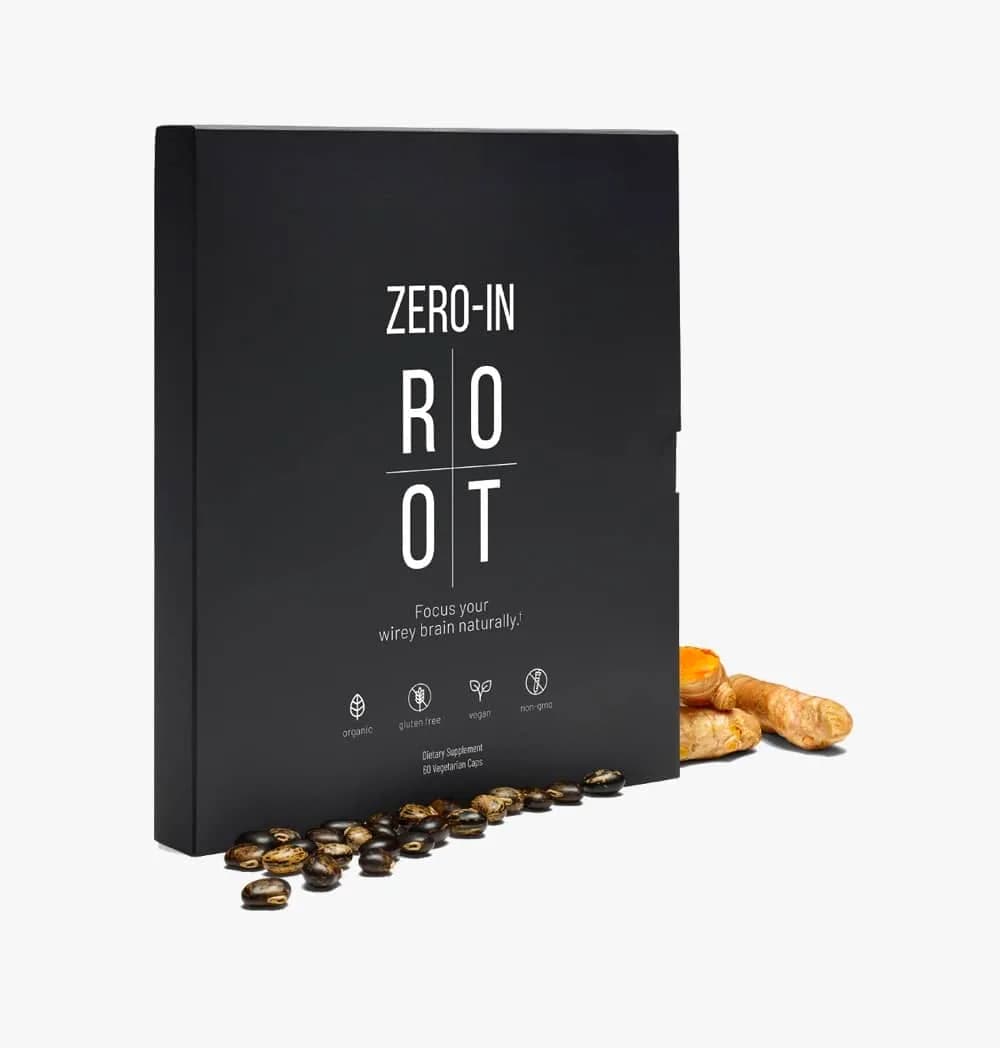
This is where Zero In belongs in the story.
Zero In's internal positioning describes the product as supporting mental clarity, sustained focus, alertness and energy, mood and motivation, and productivity.
It won't.
The idea is to support the person trying to make the better choice.
The L-Theanine + Caffeine Combination
Caffeine by itself can increase wakefulness and alertness.
But more stimulation isn't necessarily what an already overstimulated person needs.
That's why the L-theanine pairing is interesting.
Research has repeatedly examined the combination for attention performance. In one double-blind crossover trial, the combination improved attention during task switching. (PubMed)
That allows us to tell a different story about energy:
Not energy simply for being more stimulated.
Energy with somewhere to go.
N-Acetyl L-Tyrosine and Cognitive Demand
Tyrosine's relevance becomes particularly interesting under stressful or cognitively demanding conditions because it is a precursor to catecholamine neurotransmitters.
The evidence isn't uniform, and that matters.
A review concluded that research provided a weak recommendation in favor of tyrosine for cognitive stress, while emphasizing that the evidence remained insufficient for strong universal recommendations. (PubMed)
That's exactly how responsible wellness education should sound.
Support the biology.
Don't promise miracles.
The New Goal: Earn the Reward
The ultimate answer to constant digital stimulation isn't another form of constant stimulation.
It's rebuilding a relationship between:
effort → progress → reward.
Do something difficult.
Finish it.
Experience the satisfaction that comes from knowing you earned the outcome.
And if Zero In becomes part of that routine, the positioning should be simple:
Zero In supports your focus. You decide where that focus goes.
Stop Giving Every Distraction Your Best AttentionTurning off notifications and creating better habits can help protect your focus. Zero In can support the other side of that strategy with ingredients formulated for sustained focus, alertness, mental clarity, energy, and motivation.
Get Zero-In TODAY. Your attention is worth protecting .
References
Sherman LE, et al. Peer Influence Via Instagram: Effects on Brain and Behavior in Adolescence and Young Adulthood.Child Development. (PubMed Central (PMC))
Meshi D, et al. Nucleus accumbens response to gains in reputation for the self relative to gains for others predicts social media use. Frontiers in Human Neuroscience. 2013. (PubMed Central (PMC))
Einöther SJL, et al. L-theanine and caffeine improve task switching. Appetite. 2010. (PubMed)
Attipoe S, et al. Tyrosine for Mitigating Stress and Enhancing Performance in Healthy Adult Humans. 2015. (PubMed)
Pyetje të shpeshta
Why is social approval such a strong reward?
Humans are social animals, so signs of approval engage reward-related brain systems and encourage repeated checking.
What helps reduce social media distraction?
Changing the environment, for example by muting notifications and moving apps, is usually the most effective first step.
Do caffeine and L-theanine help focus?
The combination has been studied for attention, but effects vary by person and it is not a fix for digital habits.
Referencat
- Sherman LE, et al. Peer Influence Via Instagram: Effects on Brain and Behavior in Adolescence and Young Adulthood. Child Development. ( PubMed Central (PMC) )
- Meshi D, et al. Nucleus accumbens response to gains in reputation for the self relative to gains for others predicts social media use. Frontiers in Human Neuroscience. 2013. ( PubMed Central (PMC) )
- Einöther SJL, et al. L-theanine and caffeine improve task switching. Appetite. 2010. ( PubMed )
- Attipoe S, et al. Tyrosine for Mitigating Stress and Enhancing Performance in Healthy Adult Humans. 2015. ( PubMed )