
Hormone Balance vs Imbalance: What Does It Actually Mean?
Hormone balance is a popular wellness phrase, but the endocrine system is more complex than being simply balanced or unbalanced, and hormones respond to light, food, sleep, exercise, stress, age and illness. Persistent symptoms deserve proper medical testing, and lifestyle habits such as sleep, stress management and movement support overall health but do not treat hormonal disorders. This article explains what hormones do and what can realistically be done to support health.
Szerző: Root Health TürkiyeMegjelent Frissítve Olvasási idő: 8 perc
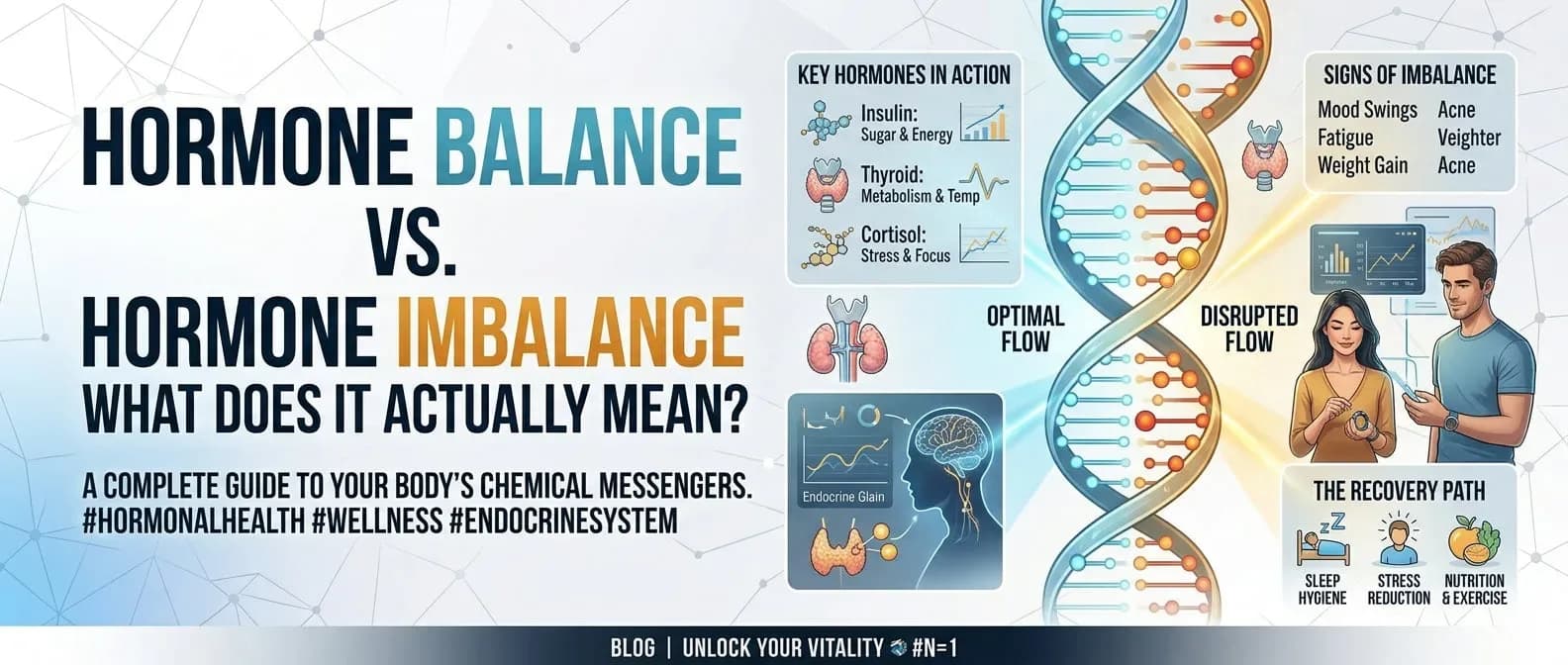
Hormone balance is a popular wellness phrase, but the endocrine system is more complex than being simply balanced or unbalanced, and hormones respond to light, food, sleep, exercise, stress, age and illness. Persistent symptoms deserve proper medical testing, and lifestyle habits such as sleep, stress management and movement support overall health but do not treat hormonal disorders. This article explains what hormones do and what can realistically be done to support health.
Feeling tired? People blame hormones.
Having trouble sleeping? Hormones.
Struggling with weight, appetite, mood, focus, or energy? Once again, hormones often enter the conversation.
Sometimes hormones really can be part of the picture. But the human endocrine system is much more sophisticated than simply being “balanced” or “unbalanced.”
Understanding what hormones actually do—and what we can realistically do to support our overall health—may be much more useful than chasing the idea of perfect hormone balance.
First, What Are Hormones?
Hormones are chemical messengers produced by glands and tissues throughout the body. They travel through the bloodstream and communicate with organs and tissues, helping regulate many essential biological processes.
According to the National Library of Medicine's MedlinePlus, hormones influence growth and development, metabolism, sexual function, reproduction, and mood.[1]
Some familiar hormones include insulin, cortisol, estrogen, progesterone, testosterone, thyroid hormones, melatonin, and adrenaline.
The important thing to understand is that these hormones don't operate independently.
They are part of an interconnected endocrine system involving the pituitary, thyroid, adrenal glands, pancreas, ovaries or testes, and other tissues.
Your body is essentially running an enormous biological communication network every second of every day.
What Does “Hormone Balance” Actually Mean?
Hormone balance doesn't mean having equal amounts of every hormone.
It doesn't even mean keeping hormone levels perfectly steady.
Hormones are supposed to change.
Cortisol normally follows a daily rhythm and helps prepare the body for wakefulness. Melatonin increases as the body prepares for sleep. Reproductive hormones fluctuate throughout different stages of life, and several hormones follow circadian or sleep-related patterns.[2][3]
A better way to think about hormone balance is having appropriate hormonal signaling and levels for your body at the appropriate time.
Your endocrine system is constantly adjusting to what is happening around and inside you.
What Happens When Hormones Become Imbalanced?
Hormonal disorders can occur when the body produces too much or too little of a hormone or when the body doesn't respond to hormonal signals appropriately.[1]
Depending on the hormonal system involved, someone might experience changes involving energy, appetite, body weight, menstrual cycles, sexual function, temperature sensitivity, mood, sleep, skin, hair, or other areas.
But this is extremely important:
Having one or more of those symptoms does not automatically mean you have a hormone imbalance.
Fatigue can have many causes. So can weight changes, poor sleep, brain fog, mood changes, or low energy.
When symptoms are significant, unexplained, or persistent, a healthcare professional can determine whether testing is appropriate. Blood, urine, and in some circumstances other laboratory tests can measure specific hormone levels.[4]
Sleep May Be More Important Than We Realize
One of the clearest examples of the relationship between lifestyle and hormones is sleep.
Our bodies operate according to circadian rhythms. The National Heart, Lung, and Blood Institute explains that different hormones are produced at different times of day and that these patterns are connected with sleep and the body's internal clocks.[2]
Cortisol normally rises as morning approaches and helps prepare us to wake. Melatonin follows another rhythm that helps prepare the body for sleep.
Research has also demonstrated relationships between sleep and several other endocrine processes, including growth hormone, thyroid-stimulating hormone, and prolactin.[3]
So when we talk about supporting healthy hormonal function, getting consistent, quality sleep deserves to be part of the conversation.
Stress Is Part of the Equation Too
Cortisol often gets labeled the “bad stress hormone,” but cortisol isn't bad.
We need it.
Cortisol helps the body respond to challenges and plays important roles in normal physiology.
The issue is that sleep, stress, and the hypothalamic-pituitary-adrenal—or HPA—axis interact with one another. Research examining sleep and the HPA axis has found that poorer sleep quality can influence the body's cortisol response to stress.[5]
This is another reminder that the systems of the body don't operate independently.
Sleep can affect stress.
Stress can affect sleep.
And both interact with the body's endocrine system.
Metabolism Is Also a Hormonal Story
When people hear “hormones,” they often immediately think about estrogen or testosterone.
But insulin is a hormone too.
So are thyroid hormones.
Hormonal signaling helps the body regulate glucose, energy use, appetite, metabolism, growth, reproduction, and many other processes.
That is why metabolic health and endocrine health are so closely connected.
It also helps explain why health is rarely as simple as telling someone to “eat less and exercise more.”
The human body is constantly receiving information, interpreting it, and responding.
Where Do ROOT Products Fit Into This Conversation?
This is where we need to make an important distinction.
Supplements are not medications intended to diagnose or treat endocrine disorders and should not be expected to fix a hormone imbalance.
Instead, ROOT's philosophy is about supporting the foundational systems and nutritional needs of the body.
Several ROOT products may fit naturally into that broader wellness conversation.
Clean Slate™ — Start With the Foundation
Clean Slate is designed to support the body's natural detoxification and elimination pathways.
ROOT's philosophy begins with creating a stronger internal foundation before asking the body to perform at its best.
This doesn't mean Clean Slate “balances hormones.”
Rather, it can be viewed as part of a broader wellness routine focused on supporting the body's natural cleansing processes.
Restore™ — Nutritional Support
Hormones don't operate in a vacuum.
The body requires vitamins, minerals, amino acids, antioxidants, and other nutrients to perform countless biological functions.
Restore was formulated to provide broad nutritional support, including vitamins, nutrients, antioxidants, and amino acids to support a healthy, active lifestyle.
Instead of thinking of Restore as a hormone product, think of it as helping provide the nutritional foundation the body needs to function normally.
Metabolism and hormonal signaling are closely connected, which makes metabolic wellness an important part of the conversation.
Again, the distinction matters.
It is a wellness product designed to support normal metabolic processes.
Zero-In™ — Focus and Cognitive Performanc e
Hormones, neurotransmitters, sleep, stress, metabolism, and cognitive performance are interconnected parts of human physiology.
Zero-In was developed to support focus, mental clarity, attention, concentration, and cognitive performance with ingredients including turmeric, pine bark, velvet bean seed, and vitamin D.
That doesn't make Zero-In a hormonal treatment.
It makes it another tool designed to support an area of wellness that can be affected when our sleep, nutrition, stress, and lifestyle aren't where they should be.
Maybe We Should Stop Chasing “Perfect Hormones”
Perhaps the biggest problem with the hormone-balance conversation is the word balance itself.
It makes us imagine that there is one perfect level where every hormone should remain.
Human biology doesn't work that way.
Hormones rise.
Hormones fall.
They respond to light, food, sleep, exercise, stress, age, reproductive stages, illness, medications, and our environment.
The goal isn't to freeze that incredibly dynamic system.
The goal is to create an environment where the body has the opportunity to regulate itself appropriately.
That means paying attention to the basics: quality sleep, good nutrition, regular movement, stress management, adequate recovery, and appropriate medical care.
Supplements can complement that foundation.
They shouldn't replace it.
Listen to Your Body, But Verify When Necessary
Your body communicates constantly.
Changes in energy, appetite, sleep, menstrual cycles, sexual function, mood, temperature sensitivity, body composition, and other areas can all be worth paying attention to.
But listening to your body doesn't mean diagnosing yourself.
If something changes significantly or doesn't feel right for an extended period, talk with a qualified healthcare professional.
Sometimes the answer may be lifestyle.
Sometimes nutrition.
Sometimes stress or sleep.
And sometimes there really is an endocrine issue that needs proper testing and treatment.
The goal should never be to blame everything on hormones.
The goal should be to understand the body better.
Because when we begin looking at sleep, nutrition, metabolism, stress, environment, movement, recovery, and hormonal signaling as interconnected systems, we start seeing health differently.
Hormone balance isn't about finding one magic supplement or achieving one perfect number. It's about supporting the entire environment in which the human body has to function.
Medical References
1. National Library of Medicine — MedlinePlus. “Hormones” and “Endocrine Diseases.” Overview of hormones, endocrine glands, hormonal signaling, and endocrine disorders.
2. National Heart, Lung, and Blood Institute (NIH). “How Sleep Works — Why Is Sleep Important?” Discussion of circadian rhythms, cortisol, sleep, metabolism, and hormonal regulation.
3. National Institutes of Health / PubMed. Research on sleep and endocrine regulation, including circadian and sleep-related patterns involving cortisol, growth hormone, thyroid-stimulating hormone, prolactin, and other hormones.
4. National Library of Medicine — MedlinePlus Medical Encyclopedia. “Hormone Levels.” Overview of laboratory testing for reproductive, thyroid, adrenal, pituitary, and other hormones.
5. van Dalfsen JH, Markus CR. “The influence of sleep on human hypothalamic-pituitary-adrenal (HPA) axis reactivity: A systematic review.” Sleep Medicine Reviews. Research examining sleep quality and cortisol stress responses.