
Dietary Diversity: More Food Choices Do Not Mean More Plants
Supermarkets stock thousands of products, yet plant variety on our plates has not grown. The convenience paradox, why plant diversity matters and a grocery cart test.
By Root Health TürkiyePublished Updated 7 min read
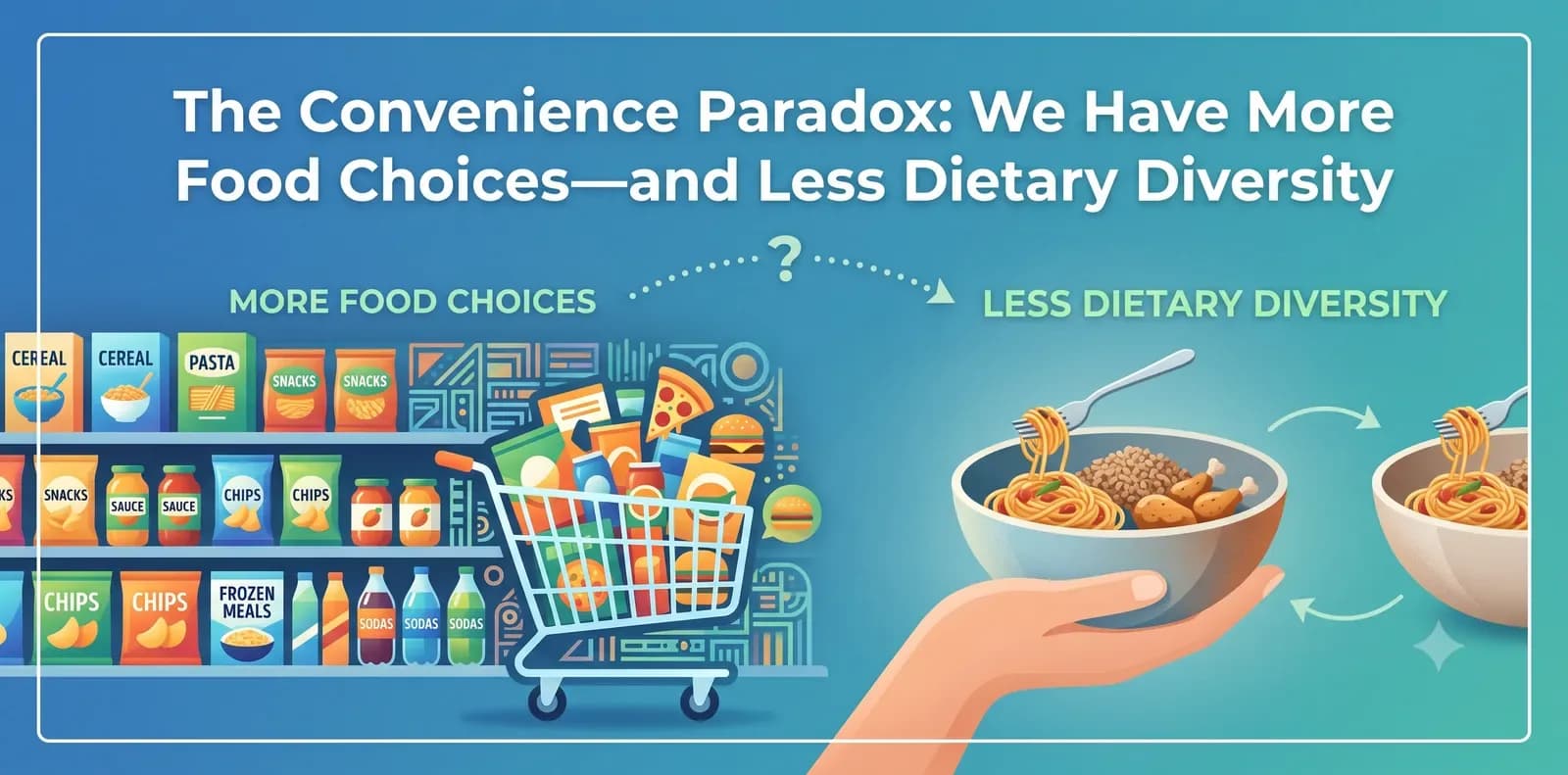
The supermarket offers more product variety than ever, but product variety is not plant variety. Many foods that look different are made from the same small group of crops: wheat, corn, soy, rice, potatoes, sugar and vegetable oil. This article looks at the gap between "choice" and "dietary diversity", why it can matter, and how to measure it in your own shopping cart.
Thousands of products, but how many different plants?
Picture a typical shop: breakfast cereal, bread, crackers, pasta, tortillas and cookies. Six products, yet several share the same main plant ingredient, wheat. Corn works the same way, turning up in cereal, chips, sweeteners and countless processed foods. The products look different, taste different and sit in different aisles, but in terms of plant diversity we may be eating the same crop again and again.
That does not make wheat or corn harmful; they have fed people for thousands of years. The real question is what follows when a handful of plants dominate the diet. Food variety and plant diversity are not the same thing.
Humanity relies on a surprisingly small menu
People have used thousands of plant species as food, yet modern agriculture rests on a much narrower group. According to the FAO's 2019 report on the state of the world's biodiversity for food and agriculture, just nine plant species (sugar cane, maize, rice, wheat, potatoes, soybeans, oil-palm fruit, sugar beet and cassava) account for about 66 percent of total crop production. Of more than 6,000 plant species cultivated for food, fewer than 200 contribute significantly to food production globally, regionally or nationally. That concentration makes sense agriculturally and economically, but nutritionally it raises the question of whether we confuse an abundance of products with an abundance of different foods.
What looks like variety may not be variety
Take an ordinary day: cereal for breakfast, a sandwich with chips at lunch, a granola bar mid-afternoon, pasta for dinner and cookies for dessert. A wide range of products, yet trace them to their main plants and the list becomes surprisingly short. Now take another day: oats, blueberries, walnuts, lentils, spinach, tomatoes, carrots, broccoli, brown rice, garlic, onion, apple and flaxseed. There are fewer packaged products, but far more plants.
The distinction matters because different plants bring different mixes of vitamins, minerals, fibers and plant compounds. Broccoli is not spinach, and blueberries are not flaxseed. The aim is not to find one perfect vegetable or "superfood" but to build a diet on variety.
Convenience changed more than our supermarkets
Modern food processing has delivered real benefits: food travels farther, keeps longer, is prepared faster, and food safety has improved in many areas. These advances should not be dismissed. But convenience also changed how we think: we choose products instead of ingredients, brands, flavors and formats instead of plants. A barbecue chip and a sour cream chip are different flavors, but both are mainly potato.
Why plant diversity deserves more attention
Nutrition has never been about one nutrient. Different foods supply different combinations of vitamins, minerals, fiber, fatty acids and plant compounds. The World Health Organization (WHO) lists diversity among the four core principles of a healthy diet, alongside adequacy, balance and moderation.
Microbiome research added a new dimension. In the American Gut Project (McDonald et al., 2018), participants who ate more than 30 different plant types a week had more diverse gut microbiomes than those who ate 10 or fewer. The groups compared were small (41 and 44 people) and the study is observational; the result does not show a magic number for everyone or that diversity alone determines gut health. It only suggests that looking at how many different plants we eat, not just how much, may be worthwhile. We explore this further in why your gut microbiome loves variety.
Ultra-processed foods add another layer
Processing is a spectrum: frozen vegetables, canned beans, yogurt and whole-grain bread are all processed, and being processed does not by itself make a food unhealthy. The concern is ultra-processed foods making up most of the diet and displacing fruit, vegetables, legumes, nuts, seeds and minimally processed foods.
In the NHANES-based study by Juul and colleagues, the share of energy from ultra-processed foods among US adults rose from 53.5 percent in 2001-2002 to 57.0 percent in 2017-2018, while the share from minimally processed foods fell from 32.7 to 27.4 percent. A 2024 BMJ umbrella review by Lane and colleagues reported that greater ultra-processed food exposure was associated with adverse health outcomes, especially cardiometabolic ones; these associations are observational and do not prove that processing is responsible for every effect. The main lesson is simpler: a diet can contain enormous product variety and still contain little plant variety.
The grocery cart test
The easiest way to see this is to look at your own cart. Count plants, not products. If you buy oatmeal, count oats; if you eat almonds, count almonds; tomato sauce gives you tomatoes, black beans give you beans, and the spinach in a smoothie is one more plant. Then look at your fruit, vegetables, herbs, whole grains, nuts, seeds and legumes.
The aim is not a perfect number or a nutritional scorecard, just noticing the pattern. Many people find they are not eating badly; they are eating the same healthy foods repeatedly. Spinach every morning, broccoli every night and blueberries every afternoon is a nutritious routine, but there is room to widen it. Spinach can sometimes become kale; broccoli can rotate with cabbage or cauliflower. Our article on the benefits of broccoli and how to cook it is a good starting point for that rotation.
Where does Relive Greens fit?
Convenience foods became popular for a reason: convenience matters. Buying a wide range of fresh produce takes planning; vegetables must be bought, stored and prepared, and some spoil fast. Travel disrupts routines and busy weeks change meal plans. That is real life, and one reason a supplement can have a practical place alongside a healthy diet.
According to Root's published ingredient information, Relive Greens is built on a range of plant ingredients rather than a single green: broccoli, kale, spinach, green cabbage, parsley, wheat grass, barley grass, alfalfa leaf, spirulina, chlorella, blueberry, pomegranate and aloe vera. On the fiber side it lists green banana flour, apple fiber, flax seed, psyllium husk and inulin, along with Bacillus coagulans and MCT coconut oil. What stands out for dietary diversity is not the count but that these come from different plant categories: crucifers, leafy greens, fruit, grasses, algae, seeds and fiber sources. See the label on the product page for current ingredients and amounts. For a comparison of similar products, see our Relive Greens vs AG1 comparison.
A powder does not replace the produce aisle
That does not mean Relive Greens replaces vegetables or is an excuse not to eat them. Whole plant foods provide water, fiber, nutrients, physical structure and complex mixtures of compounds; a scoop of greens powder is not nutritionally identical to a plate of vegetables, fruit, legumes, nuts and seeds. The realistic strategy is to use both: eat the broccoli, buy berries, try lentils, rotate leafy greens, add nuts and seeds, pick a vegetable you have never cooked. When your schedule slips or variety falls short, a powder can be a practical way to complement the rest.
Sources
- FAO (2019), The State of the World's Biodiversity for Food and Agriculture, Rome.
- World Health Organization: healthy diet fact sheet.
- McDonald D et al. (2018), mSystems 3(3): American Gut: an open platform for citizen science microbiome research.
- Juul F et al. (2022), American Journal of Clinical Nutrition 115(1):211-221: ultra-processed food consumption among US adults from 2001 to 2018.
- Lane MM et al. (2024), BMJ 384: ultra-processed food exposure and adverse health outcomes, umbrella review of epidemiological meta-analyses.
Conclusion
Having thousands of products to choose from does not mean your diet is diverse; sometimes it only shows that the same small group of plants has been turned into thousands of products. On your next shop, look past the package at the plants, and add two or three new ones to your cart.
Frequently asked questions
What is dietary diversity?
Dietary diversity means regularly eating many different foods, and especially many different plants. The WHO lists diversity among the four core principles of a healthy diet, with adequacy, balance and moderation.
What is the difference between product variety and plant diversity?
Many different products in a supermarket are made from the same few plants (wheat, corn, soy, rice, potatoes, sugar, vegetable oil). The product count can be high while the plant count is low.
Do I have to eat 30 different plants a week?
No. In the American Gut Project, people eating more than 30 plant types a week had more diverse microbiomes, but the study is observational and the groups were small. There is no magic number; the aim is to add new plants to the ones you already eat.
How can I increase plant diversity?
Count plants, not products, in your cart, then add two or three new ones: a different vegetable, legume, seed or fruit. Rotating a favorite vegetable with a related crucifer or green also works.
Does Relive Greens replace eating vegetables?
No. According to Root's published ingredient information it contains a range of plant ingredients and fiber sources, but it does not replicate the water, fiber and structure of whole vegetables; at most it complements variety.
References
- World Health Organization: healthy diet fact sheet
- McDonald D et al. (2018), mSystems 3(3): American Gut: an open platform for citizen science microbiome research
- Juul F et al. (2022), American Journal of Clinical Nutrition 115(1):211-221: ultra-processed food consumption among US adults from 2001 to 2018
- Lane MM et al. (2024), BMJ 384: ultra-processed food exposure and adverse health outcomes, umbrella review of epidemiological meta-analyses