
Is Your Phone Hijacking Your Reward System? Dopamine, Focus and Tyrosine
Smartphones deliver frequent rewards, cues and distractions that engage the brain's dopamine system, which is more about wanting and motivation than about pleasure itself. Changing your environment, such as muting notifications and setting phone-free times, is the most effective first step, while nutrients such as tyrosine are discussed as support for the dopamine pathway but are not a fix. This first part of the Hooked series explains the science.
By Root Health TürkiyePublished Updated 5 min read
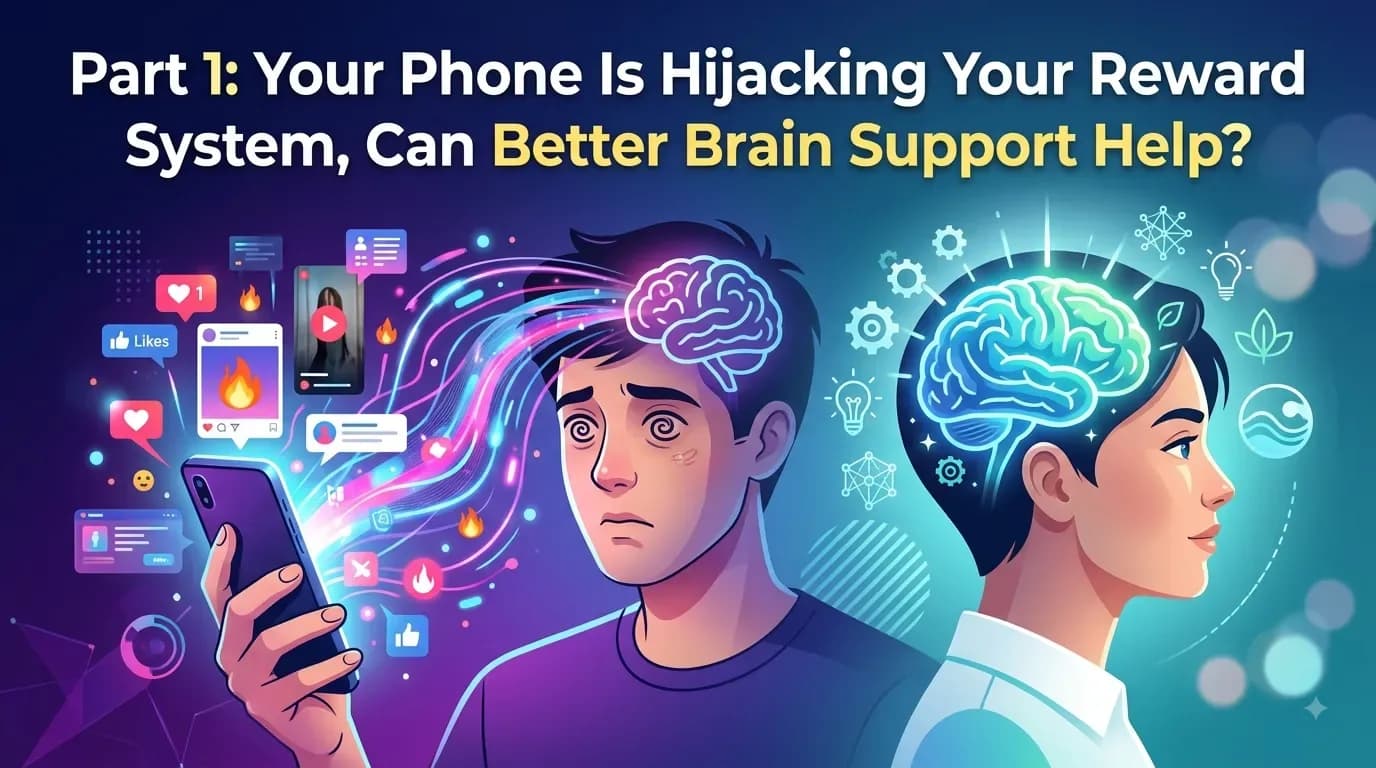
Smartphones deliver frequent rewards, cues and distractions that engage the brain's dopamine system, which is more about wanting and motivation than about pleasure itself. Changing your environment, such as muting notifications and setting phone-free times, is the most effective first step, while nutrients such as tyrosine are discussed as support for the dopamine pathway but are not a fix. This first part of the Hooked series explains the science.
A few minutes later, you're watching a video. Then another. You check a notification, open another app, scroll through a few posts and suddenly realize 30 minutes have disappeared.
Sound familiar?
The problem may not simply be a lack of discipline.
Modern smartphones and social platforms place an extraordinary number of rewards, cues and distractions within inches of us all day long. And many of those cues interact with the same brain systems responsible for motivation, reward-seeking and attention.
That was one of the central ideas behind HOOKED: How Your Phone Is Rewiring Your Brain: the goal isn't necessarily to eliminate technology. It's to understand the loop well enough to regain control of it.
Dopamine: More About Wanting Than Happiness
Dopamine is frequently described as the brain's "pleasure chemical," but that's an oversimplification.
Dopamine plays an important role in motivation, learning, anticipation and the drive to pursue rewards.
In other words, dopamine is heavily involved in wanting.
And a smartphone can provide an almost endless supply of things to want.
What's the next video?
Did somebody like my post?
Who sent that notification?
Is there a new message?
What happened while I was away?
Each question creates another reason to look.
Research into social feedback has even shown that receiving and giving "likes" can engage brain areas associated with reward processing, including the nucleus accumbens and ventral tegmental area. (PubMed Central (PMC))
That doesn't mean every social-media interaction is an "addiction."
It does mean that digital social rewards can engage some of the same neural circuitry involved in motivation and reinforcement.
What Happens to Focus?
The problem becomes especially noticeable when the brain moves from rapid digital stimulation back to something requiring sustained effort.
Reading a report.
Studying.
Writing.
Having a long conversation.
Working on a project without checking your phone.
Those activities don't provide a new reward every five seconds.
Research examining smartphones and cognition has found evidence that smartphone engagement can interfere with ongoing attention, although researchers appropriately caution that evidence about permanent long-term changes in attentional capacity remains mixed. (PubMed Central (PMC))
That's an important distinction.
We're not saying your phone has permanently damaged your brain.
We're saying the environment you're creating can make sustained attention harder.
And environments can be changed.
But Behavior Is Only One Side of the Conversation
Turning off notifications helps.
Putting the phone in another room helps.
Creating periods of uninterrupted work helps.
Getting adequate sleep, movement and sunlight matters too.
But there's another question worth asking:
Are we giving the brain the nutritional building blocks it needs to support normal cognitive performance in the first place?
That's where Zero In enters this conversation.
Zero In was formulated around several different aspects of cognitive support rather than simply delivering stimulation.
Its key ingredients include:
- N-acetyl L-tyrosine
- Velvet bean seed (Mucuna pruriens)
- L-theanine
- Caffeine
- Vitamin D3
- Pine bark extract
- Turmeric root extract
ROOT's formulation materials position N-acetyl L-tyrosine and velvet bean around the dopamine pathway, L-theanine plus caffeine around focused alertness, and vitamin D3 around serotonin-related biology.
That doesn't mean taking Zero In makes your phone less distracting.
Instead, think about the strategy in two parts:
Reduce what is constantly stealing your attention. Support the systems involved in giving you attention to use.
Tyrosine and the Dopamine Pathway
Tyrosine is an amino acid and a biochemical precursor used in the production of catecholamine neurotransmitters, including dopamine.
Research has particularly examined supplemental tyrosine during stressful or cognitively demanding conditions. A review of randomized trials found some evidence favoring tyrosine for cognitive performance under stress, although the authors characterized the overall evidence as limited and not strong enough for sweeping conclusions. (PubMed)
That's the type of distinction good nutritional science requires.
Zero In isn't "giving you focus."
It's providing ingredients connected to biological pathways involved in cognitive performance while you create behaviors that give that brain somewhere productive to direct its attention.
Take Back the Loop
Try this tomorrow morning:
Don't open social media immediately after waking.
Give yourself a period without rapid digital input.
Get some light.
Move your body.
Decide what deserves your attention before an algorithm decides for you.
Then support the nutritional side of your routine.
The goal isn't to hate your phone.
The goal is to make your phone a tool again.
Control the loop instead of living inside it.
Ready to Take Back Your Focus? Reducing digital distractions is one part of the equation. Supporting the nutritional pathways involved in focus, alertness, and cognitive performance is another. Zero In was formulated with targeted ingredients designed to support mental clarity, sustained focus, energy, and motivation—so you can spend less time reacting and more time directing your attention where it matters. Take control of the loop.
References
Sherman LE, et al. What the brain “Likes”: neural correlates of providing feedback on social media. Social Cognitive and Affective Neuroscience. 2018. (PubMed Central (PMC))
Wilmer HH, Sherman LE, Chein JM. Smartphones and Cognition: A Review of Research Exploring the Links between Mobile Technology Habits and Cognitive Functioning. Frontiers in Psychology. 2017. (PubMed Central (PMC))
Attipoe S, et al. Tyrosine for Mitigating Stress and Enhancing Performance in Healthy Adult Humans. Military Medicine. 2015. (PubMed)
Frequently asked questions
Is dopamine the pleasure chemical?
Not exactly. Dopamine is more about wanting, motivation and pursuing rewards than about pleasure itself.
What is the best first step to reduce phone distraction?
Changing your environment, such as muting notifications and setting phone-free times, is usually the most effective first step.
Does tyrosine fix phone habits?
No. Tyrosine is a building block of dopamine and is discussed as support, but it does not replace behavioural changes.
References
- Sherman LE, et al. What the brain “Likes”: neural correlates of providing feedback on social media. Social Cognitive and Affective Neuroscience. 2018. ( PubMed Central (PMC) )
- Wilmer HH, Sherman LE, Chein JM. Smartphones and Cognition: A Review of Research Exploring the Links between Mobile Technology Habits and Cognitive Functioning. Frontiers in Psychology. 2017. ( PubMed Central (PMC) )
- Attipoe S, et al. Tyrosine for Mitigating Stress and Enhancing Performance in Healthy Adult Humans. Military Medicine. 2015. ( PubMed )