What Is Inflammaging? Chronic Low-Grade Inflammation and Aging
What inflammaging is, why it is not a diagnosis, and what meta-analyses say about exercise and Mediterranean-style eating on inflammation markers.
By Root Health TürkiyePublished Updated 6 min read
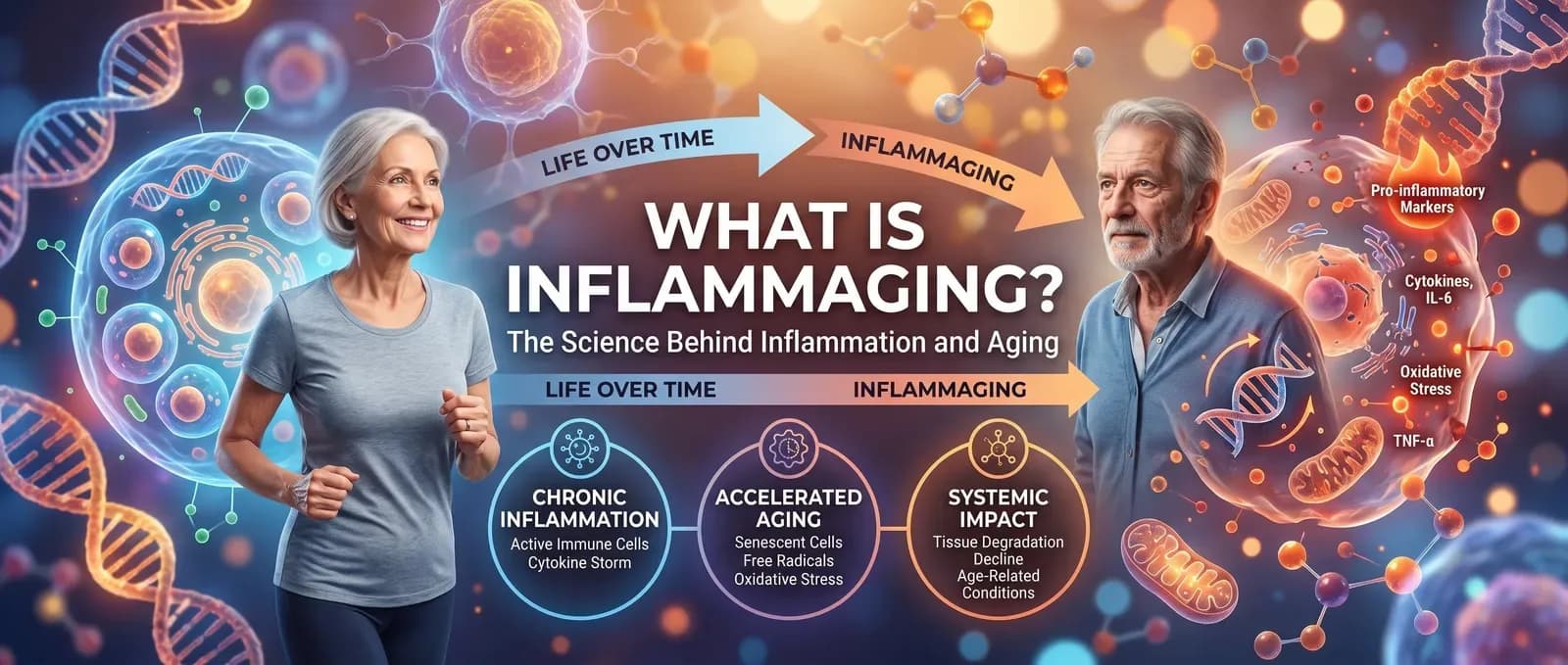
Inflammaging, a blend of inflammation and aging, is a research term for the chronic, low-grade, usually unfelt rise in inflammatory signaling that tends to accompany growing older. It is not a medical diagnosis, no single blood test scores it, and no one supplement switches it off. Studies suggest that movement, a Mediterranean-style eating pattern, sleep and not smoking can shift related markers in a favorable direction, though it is not established that these shifts always translate into lasting health outcomes.
What is inflammaging?
The idea emerged in aging biology around the turn of the century, and a 2014 review by Franceschi and Campisi discussed it as a possible link between chronic inflammation and age-associated disease. The key words are chronic, low-grade and age-related. Redness, warmth and swelling around a cut finger is acute inflammation: it is fast, purposeful and temporary. Inflammaging is a shift in signaling levels that can persist in the background for years, even when there is no obvious wound or infection.
It is worth repeating that this is not a diagnosis. Doctors do not diagnose "inflammaging"; researchers use the word to describe patterns seen in older people.
Why might inflammation rise with age?
There is probably no single explanation. Several systems appear to influence one another over decades, and these are the factors studied most often:
- Cellular senescence: Some damaged cells stop dividing and can release inflammatory molecules into their surroundings.
- Immune changes: In what is called immunosenescence, parts of immunity weaken while background inflammatory signaling may increase.
- Body composition: Muscle often declines and visceral fat, the fat around internal organs, often grows; fat tissue is not just an energy store but an active tissue that releases signaling molecules.
- Metabolic health, mitochondria and oxidative stress: Less efficient cellular energy production and accumulated damage can accompany the picture.
- Gut microbiome and environment: Age-related changes in the microbiome and chronic infections are also being studied.
That is why there is no single "inflammaging pathway" to shut down. A 2018 review by Ferrucci and Fabbri examines the relationship of this low-grade inflammation with aging, cardiovascular disease and frailty, presenting it as a complex network rather than a one-way cause and effect.
Is inflammation always bad?
No. Inflammation is part of the defense and repair system that responds to injury and infection. Even exercise temporarily raises some inflammatory signals without making exercise harmful. The concern in this research is not normal, short-lived inflammation but inflammatory activity that stays dysregulated over time. So the goal cannot be to "eliminate inflammation"; supporting the body's ability to keep its physiological balance is a more realistic frame.
Can inflammaging be measured?
There is no routine "inflammaging score". Researchers look at markers such as C-reactive protein (CRP), high-sensitivity CRP, interleukin-6 (IL-6) and tumor necrosis factor-alpha (TNF-α). But these are not specific to aging: CRP can rise with infection, injury, autoimmune conditions and many other situations. One high value does not mean you are aging faster, and a clinician needs the full context to interpret any result.
Can lifestyle influence it?
Exercise
A 2023 systematic review and meta-analysis by Khalafi and colleagues (40 studies) reported that exercise training lowered IL-6, TNF-α and CRP in older adults, with different exercise types standing out for different markers. A 2025 systematic review also examined the effect of aerobic exercise on chronic inflammation in older adults. Still, you do not need to exercise just to move a lab number; it also supports cardiovascular fitness, strength, bone health, mood and independence.
Mediterranean-style eating
A 2026 meta-analysis by Keshani and colleagues in Nutrition Reviews pooled 33 randomized controlled trials with 3,476 participants. Mediterranean-diet interventions significantly lowered high-sensitivity CRP, IL-6 and IL-17, but there were no significant effects on CRP, IL-10, TNF-α or total antioxidant capacity. In other words, food does not switch inflammation off; some markers move and others do not. For a plant-rich pattern, see our articles on the gut microbiome and dietary variety and on why more food choices are not more plants.
Sleep, smoking and metabolic health
Sleep and immune regulation are closely linked, and repeatedly cutting sleep is not a longevity strategy. Smoking exposes the body to many harmful compounds and contributes to oxidative stress and inflammatory processes. For keeping muscle and getting enough protein, our guide on how much protein you need may help.
How to read "anti-inflammatory" supplement claims
Certain nutrients and plant compounds have been studied for effects on inflammatory pathways or markers. But changing a biomarker does not prove that a supplement slows aging, extends lifespan, prevents age-related disease or "reverses inflammaging"; those are much bigger claims that need much stronger evidence. When you evaluate a supplement, ask:
- What was tested? The finished product or a single ingredient?
- In whom? A human trial, or cell and animal work?
- How many people, for how long?
- What was measured? A lab marker or an actual health outcome?
For a wider framework, read how to judge supplement ingredient quality. You can find Root's Restore on its product page; nothing in this article means that Restore or any other supplement affects aging or inflammation.
Look at healthy years, not one number
Modern wellness culture loves numbers: biological age, CRP, heart rate variability, glucose, steps. These can sometimes be informative, but no single one defines your health. Instead of "how do I lower inflammation?", a more productive question is "what can I consistently do to give my body the healthiest environment as I age?" Researchers increasingly talk about healthspan, the part of life spent in relatively good health. Its foundations are unglamorous: move, preserve muscle, eat nutritious food, sleep enough, stay socially connected, avoid smoking, monitor metabolic risk factors and use appropriate preventive care.
References
- Franceschi C, Campisi J. Chronic inflammation (inflammaging) and its potential contribution to age-associated diseases. J Gerontol A Biol Sci Med Sci. 2014;69(Suppl 1):S4-S9. doi.org/10.1093/gerona/glu057.
- Ferrucci L, Fabbri E. Inflammageing: chronic inflammation in ageing, cardiovascular disease, and frailty. Nat Rev Cardiol. 2018;15(9):505-522. doi.org/10.1038/s41569-018-0064-2.
- Calder PC, Bosco N, Bourdet-Sicard R, et al. Health relevance of the modification of low grade inflammation in ageing (inflammageing) and the role of nutrition. Ageing Res Rev. 2017;40:95-119. doi.org/10.1016/j.arr.2017.09.001.
- Keshani M, Rafiee S, Heidari H, et al. Mediterranean diet reduces inflammation in adults: a systematic review and meta-analysis of randomized controlled trials. Nutr Rev. 2026;84(9):1776-1790. doi.org/10.1093/nutrit/nuaf213.
- Khalafi M, Akbari A, Symonds ME, et al. Influence of different modes of exercise training on inflammatory markers in older adults with and without chronic diseases: a systematic review and meta-analysis. Cytokine. 2023;169:156303. doi.org/10.1016/j.cyto.2023.156303.
- Tayebi SM, Poorhabibi H, Heidary D, Amini MA, Sadeghi A. Impact of aerobic exercise on chronic inflammation in older adults: a systematic review and meta-analysis. BMC Sports Sci Med Rehabil. 2025;17:229. doi.org/10.1186/s13102-025-01279-z.
Conclusion
Inflammaging is a research concept for age-related, low-grade inflammation; it is not a diagnosis and cannot be "solved" with one intervention. The evidence leans most on basic habits such as movement, Mediterranean-style eating, sleep and not smoking, while for supplements the path from a marker change to a health outcome is mostly unproven. If you are concerned about inflammation markers or symptoms, talk to a doctor.
Frequently asked questions
What is inflammaging?
A research concept for the chronic, low-grade rise in inflammatory signaling that accompanies aging. It is not a medical diagnosis.
Can inflammaging be measured with a blood test?
There is no routine inflammaging test. Markers such as CRP, IL-6 and TNF-α are used in research, but they are not specific to aging and rise in many situations, including infection.
Do exercise and diet affect inflammation markers?
Meta-analyses report lower IL-6, TNF-α and CRP with exercise in older adults and lower hs-CRP, IL-6 and IL-17 with Mediterranean-diet interventions, while some markers did not change significantly.
Can supplements reverse inflammaging?
That has not been shown. Seeing a biomarker change does not mean a supplement slows aging or protects against disease.
Is eliminating inflammation a good goal?
No. Inflammation is part of the defense and repair system; the aim is to support balance, not to remove it.
References
- Franceschi and Campisi 2014, J Gerontol A: chronic inflammation (inflammaging)
- Ferrucci and Fabbri 2018, Nat Rev Cardiol: inflammageing, cardiovascular disease and frailty
- Calder et al. 2017, Ageing Res Rev: low-grade inflammation and the role of nutrition
- Keshani et al. 2026, Nutr Rev: Mediterranean diet and inflammation meta-analysis
- Khalafi et al. 2023, Cytokine: exercise training and inflammatory markers
- Tayebi et al. 2025, BMC Sports Sci Med Rehabil: aerobic exercise and chronic inflammation