Does More Ingredients Mean a Better Supplement? A Label-Reading Guide
A long ingredient list does not signal quality. Here is how to read a supplement label for dose, evidence and transparency, with a two-ingredient example.
By Root Health TürkiyePublished Updated 4 min read
No: the number of ingredients in a supplement is not a measure of its quality. A long label does not mean every ingredient is present in an effective amount, in good quality, and for a meaningful reason. The more telling questions are these: how much of each ingredient is in a serving, is there evidence behind that amount, and does the label show it clearly?
Why do labels keep getting longer?
In the supplement market a long ingredient list is easily read as "more value". Adding biotin, vitamin C, hyaluronic acid, probiotics and digestive enzymes to a collagen product is attractive for marketing. But a name appearing on a label does not tell you it is present at a useful dose.
Every added ingredient brings a new question
- Dose: A capsule or scoop has limited volume. As the number of ingredients rises, the amount left for each can shrink. The amount of an ingredient used in studies may not be the amount in the product.
- Evidence: Each ingredient has its own level of evidence. If no study covers the blend as a whole, studies on single ingredients do not prove the effect of the mix.
- Interactions and tolerance: The more ingredients, the harder it is to tell which one caused a problem.
- Cost: You want to know whether you are paying for recognizable ingredients in measurable amounts with some chance of working, or for filler that merely lengthens the list.
What does "proprietary blend" mean?
Under US regulation (21 CFR 101.36), a supplement with a proprietary blend must show on the label the blend's name, the ingredients in it and the total weight of the blend, but it is not required to give the amount of each ingredient separately. Ingredients are listed in order of predominance. So you may learn that a ten-ingredient blend weighs 500 mg without learning how much of it is the ingredient that matters. Where possible, prefer labels that show amounts one by one.
Is simpler always better?
No; simplicity is not proof of quality in itself. A well-dosed, well-tested multi-ingredient product can beat a poor two-ingredient one. The advantage of simplicity is that it can be questioned: with two ingredients it is easy to check what each is, how much is present and what evidence exists.
A two-ingredient example: GMBMY
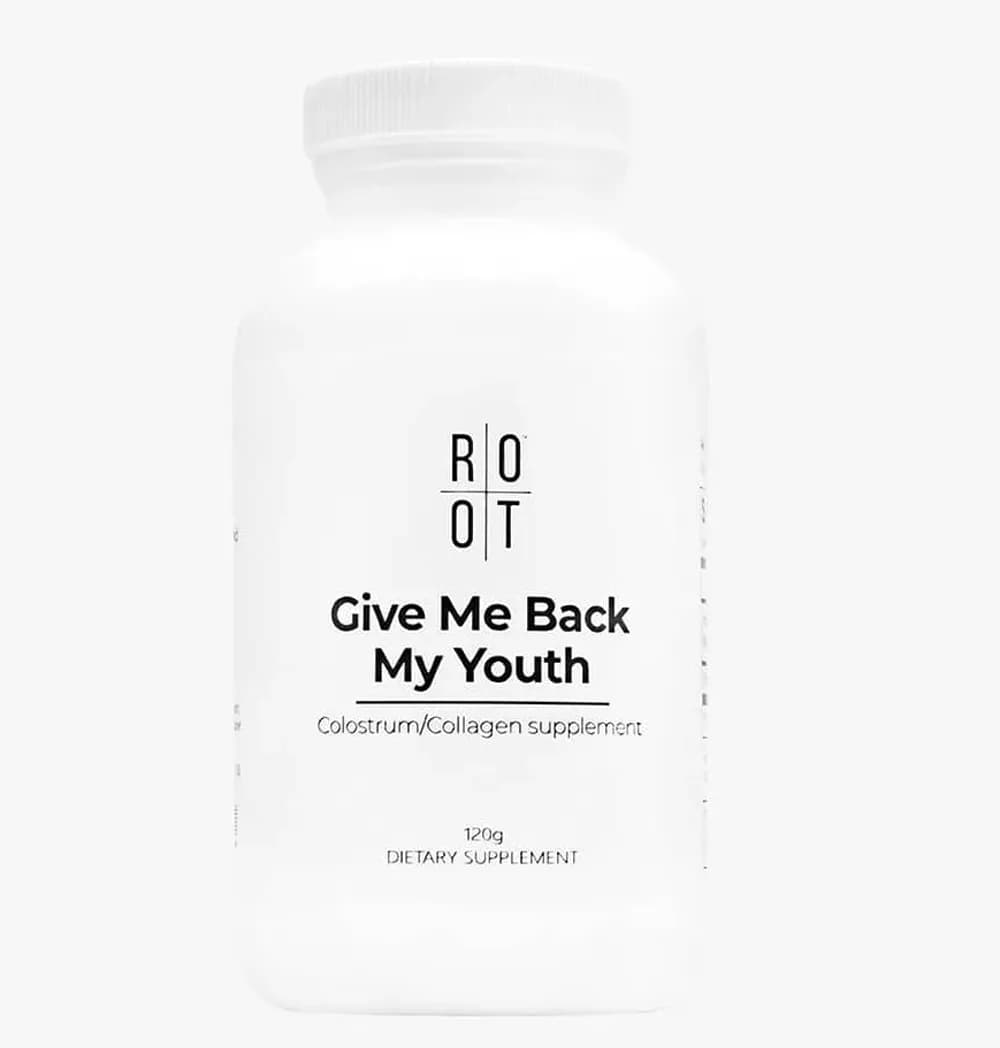
According to Root, GMBMY is built around just two main ingredients: hydrolyzed bovine collagen and whole bovine colostrum powder. See the label on the product page for the current ingredient list, serving and allergen information; colostrum is a dairy-derived ingredient. We cover what these two ingredients are, and how much evidence exists, in separate articles:
- For collagen, see hydrolyzed collagen vs collagen peptides,
- For colostrum and how it relates to collagen, see collagen vs colostrum supplements,
- For the two taken together, see the bovine collagen with colostrum guide.
Studies on each of these ingredients are limited and results vary from person to person. We cannot offer evidence on this page for a claim that the two ingredients show synergy, so we do not make one.
Questions to ask while reading a label
- Is the amount of each ingredient per serving stated?
- Are there individual amounts rather than a "proprietary blend"?
- Is the form of the ingredient specified (for example hydrolyzed collagen, collagen type, source)?
- Are additives, fillers, sweeteners and allergens clearly listed?
- Can you explain in one sentence why each ingredient is there?
- Does the maker mention third-party testing or manufacturing standards? We explain how to judge that in our article on ingredient quality.
The regulatory reality
The US Food and Drug Administration (FDA) does not approve supplements before they are sold; the responsibility to evaluate safety and labeling lies with the manufacturer, and FDA can act after a product reaches the market. That is why you need to read the label yourself and question the claims.
Sources
- US Food and Drug Administration (FDA): Dietary Supplements.
- Electronic Code of Federal Regulations: 21 CFR 101.36, nutrition labeling of dietary supplements.
Conclusion
A long label is not quality; quality is measured in amounts, evidence and transparency. When choosing a supplement, look not at how many ingredients it has but at the reason for and amount of each one.
Frequently asked questions
Does a higher ingredient count mean a better supplement?
No. The number of ingredients does not indicate quality; the amount, form and evidence behind each ingredient, and how clear the label is, matter more.
What is a proprietary blend?
The label shows the blend's name, its ingredients and the total weight, but may not give the amount of each ingredient separately, which makes the dose per ingredient hard to know.
Is a supplement with fewer ingredients always better?
No. Simplicity alone is not proof of quality, but with fewer ingredients it is easier to question each one and check its amount and evidence.
How many ingredients does GMBMY have?
According to Root it is built around hydrolyzed bovine collagen and whole bovine colostrum powder. See the label on the product page for the current ingredients, serving and allergen information; it contains a dairy-derived ingredient.
Does the FDA approve supplements?
No. The FDA does not approve supplements before sale; safety and labeling are the manufacturer's responsibility, and the FDA can act after a product reaches the market.