Does Collagen Help You Lose Weight? What the Research Does and Does Not Say
Collagen does not cause weight loss on its own. We look at the body-fat findings in some studies, where the evidence stops, and how collagen can fit into a daily routine.
By Root Health TürkiyePublished Updated 5 min read
Collagen does not make you lose weight on its own. In some studies it has been linked to small changes in body-fat measurements, but the evidence is limited and far from settled. It is more realistic to think of collagen peptides as a way to add protein to your day, not as a weight-loss tool, and they cannot replace the basics: energy balance, protein quality, resistance training and sleep.
Collagen and body weight: what we know and what we do not
Collagen is the most abundant protein in the body, and supplements are usually sold in a hydrolyzed form, broken down into small peptides. Online you will often see claims like "collagen burns fat", yet the human studies behind them are few, short and based on different collagen sources. Below we look at how far the evidence goes and how collagen can fit into a daily routine. If you are unsure what peptides are, start with our piece on hydrolyzed collagen versus collagen peptides.
What does the research show?
One placebo-controlled trial on body fat
In a 2019 Marine Drugs trial by Tak and colleagues, 90 overweight adults took either 2 grams a day of low-molecular-weight collagen peptides from skate skin or a placebo for 12 weeks. The collagen group lost more body-fat percentage and fat mass than the placebo group, and no notable side effects were reported. That is interesting, but it is a single trial that used one particular fish source at one particular amount. It cannot be assumed to apply to bovine collagen.
The wider picture from systematic reviews
A 2021 systematic review in Amino Acids by Khatri and colleagues examined 15 randomized controlled trials of collagen peptides combined with exercise. According to the authors, the clearest benefit was for joint function and pain, while body composition and muscle recovery showed only modest improvements. The review also reports that 15 g a day raised collagen synthesis rates but did not significantly change muscle protein synthesis compared with higher-quality proteins, and the authors say the mechanisms are unclear.
In short, the findings on body fat are encouraging but unconfirmed. "Collagen makes you lose weight" does not match this evidence; "in some studies it was associated with body-composition measures" does.
Possible indirect roles in weight management
Because collagen is a protein, some of what we know about protein and weight management reflects on it, but it should not be presented as collagen-specific proof.
- Satiety: A 2020 review by Moon and Koh links higher-protein eating patterns to changes in appetite hormones, such as rising GLP-1 and cholecystokinin and falling ghrelin. That applies to protein in general; direct data on collagen peptides and fullness are limited.
- Keeping lean mass: Preserving lean mass during weight loss matters, and the main drivers are enough protein and resistance training. Collagen is incomplete in amino acid terms (it has almost no tryptophan), so it should not be your main protein for muscle.
- Staying active: The joint-function and pain findings in the Khatri review suggest a possible way collagen could help people keep training. That is an indirect possibility, not a direct effect on weight. We cover it in bovine collagen peptides and joint health.
Do not swap collagen for complete protein
Eggs, fish, poultry, legumes and yogurt supply all the essential amino acids. Collagen does not replace them; treat it as an addition to the protein you already eat. We explain how to estimate your daily needs in how much protein is enough.
Practical tips
- Build the foundation first: Regular meals, vegetables and fiber, enough water, sleep and a few resistance sessions a week matter far more for weight management than collagen.
- Mind the amount: Studies used anything from 2 g to 15 g a day. Collagen powder also has calories (about 4 kcal per gram of protein), so using more brings no advantage.
- Choose the source: For differences between bovine, marine and other sources, see marine collagen versus collagen peptides. If you have a fish or dairy allergy, check the source and the label carefully.
- Timing is flexible: Our post on using collagen peptides in a workout or weight-loss program has practical examples; the evidence does not show that one time of day is better.
- Read the label: For sugar, fillers and unclear blends, our guide to supplement ingredient quality can help.
One example: GMBMY
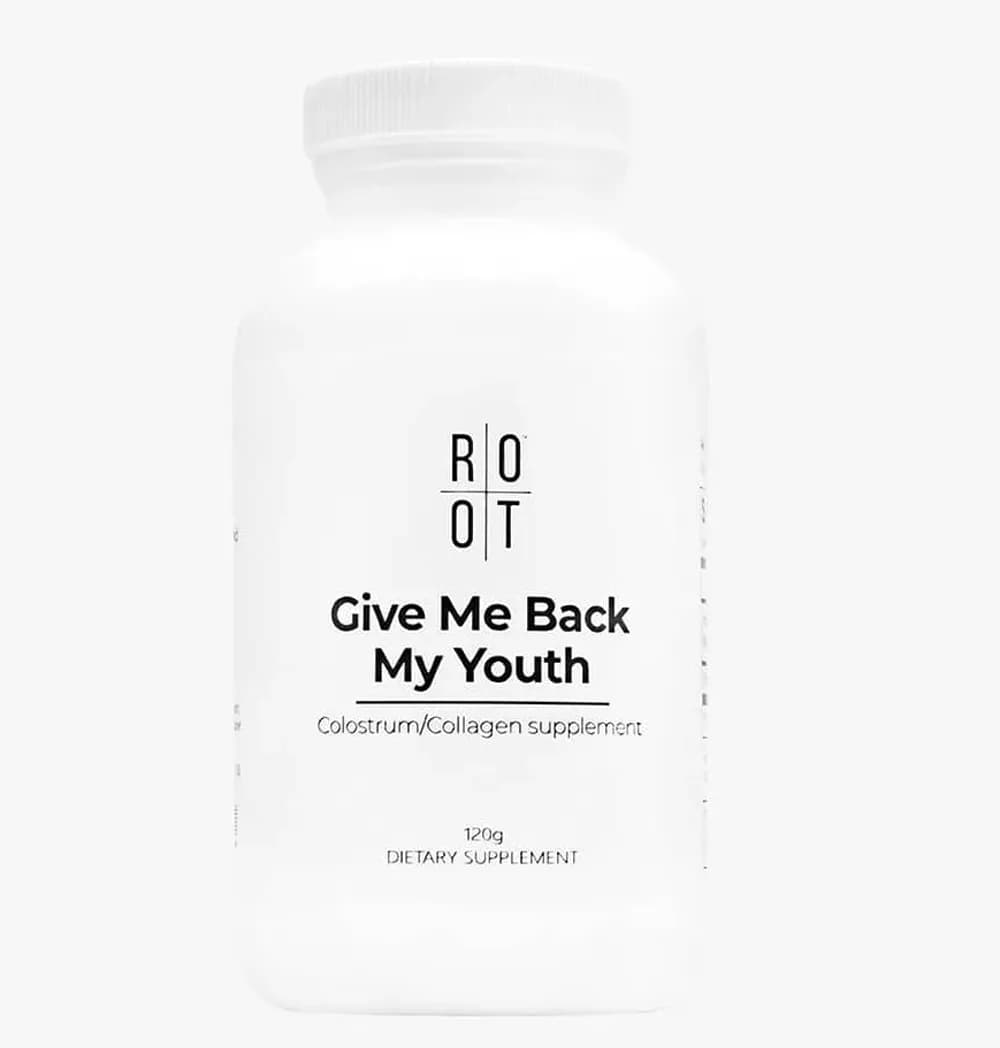
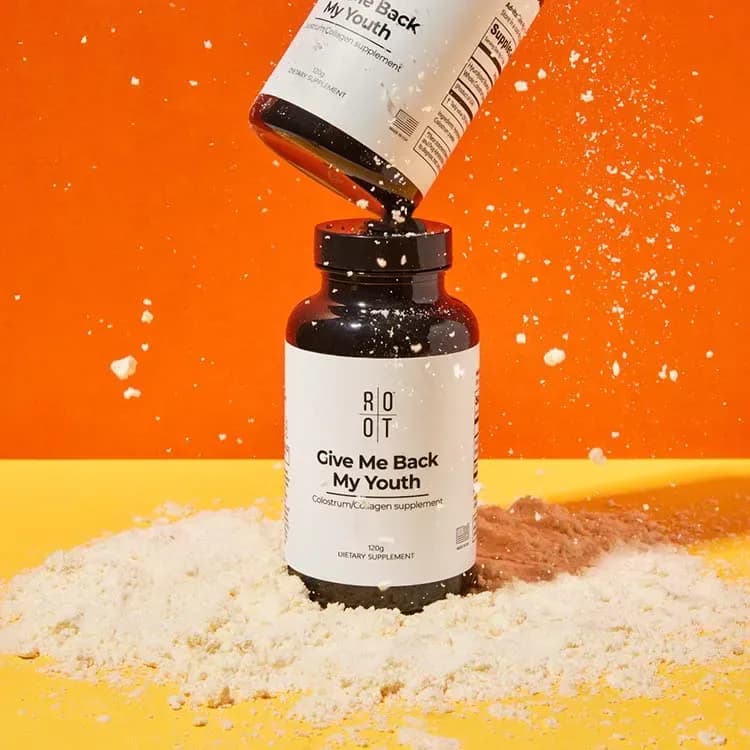
According to Root, Give Me Back My Youth (GMBMY) is a powder that combines hydrolyzed bovine collagen with whole bovine colostrum. See the label on the product page for current ingredients, serving size and allergens; colostrum is dairy-derived. We make no claim that this product, or any collagen, causes weight loss. For how the two ingredients differ, read our collagen versus colostrum comparison, or see the collagen ingredient page for an overview.
References
- Tak YJ, Kim YJ, Lee JG, et al. Effect of oral ingestion of low-molecular collagen peptides derived from skate (Raja kenojei) skin on body fat in overweight adults: a randomized, double-blind, placebo-controlled trial. Marine Drugs. 2019;17(3):157. doi.org/10.3390/md17030157.
- Khatri M, Naughton RJ, Clifford T, Harper LD, Corr L. The effects of collagen peptide supplementation on body composition, collagen synthesis, and recovery from joint injury and exercise: a systematic review. Amino Acids. 2021;53(10):1493-1506. doi.org/10.1007/s00726-021-03072-x.
- Moon J, Koh G. Clinical evidence and mechanisms of high-protein diet-induced weight loss. Journal of Obesity & Metabolic Syndrome. 2020;29(3):166-173. doi.org/10.7570/jomes20028.
Conclusion
Collagen will not make you lose weight. At most it is an option that may contribute to protein intake and joint comfort alongside a well-built nutrition and exercise routine. Keeping expectations realistic spares you both disappointment and unnecessary spending.
Frequently asked questions
Does collagen help you lose weight?
Not on its own. Some studies link it to body-fat measurements, but the evidence is limited; diet, activity and sleep drive weight management.
Does collagen make you feel full?
Protein in general is linked to satiety hormones, but direct data on collagen peptides are limited, so we cannot say collagen reliably improves fullness.
Does collagen build muscle?
Collagen is an incomplete protein with almost no tryptophan. One review found no clear advantage over higher-quality proteins for muscle protein synthesis; enough protein and resistance training remain the basics.
How much collagen do studies use?
Studies have used amounts from about 2 g to 15 g a day. Follow the label and ask a health professional about the amount that suits you.
Does GMBMY help with weight loss?
We make no such claim. According to Root, GMBMY is a powder with hydrolyzed bovine collagen and whole bovine colostrum; see the label on the product page for ingredients and allergens.
References
- Tak et al. 2019, Marine Drugs: skate-skin collagen peptides and body fat in overweight adults
- Khatri et al. 2021, Amino Acids: collagen peptide supplementation, body composition and recovery (systematic review)
- Moon and Koh 2020, Journal of Obesity & Metabolic Syndrome: high-protein diet-induced weight loss